
When the government steps in to lower mortgage rates, who actually pays the price?
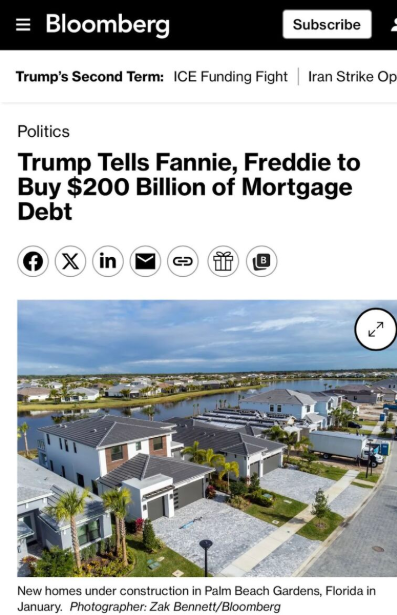
That question came up for me after reading a Bloomberg piece about President Trump directing Fannie Mae and Freddie Mac to buy $200 billion in mortgage-backed securities.
The administration’s goal was to push mortgage rates down and make housing more affordable. The idea is straightforward: Create more demand for those securities, drive yields lower, and mortgage rates follow.
In the short term, that’s exactly what happened. Rates came down.
It may or may not have been a perfect policy solution, but I was more interested in the notion that someone was at least trying something. Instead of treating housing affordability as untouchable, there was at least an attempt to move the needle.
Housing is approximately 30% of the basket that makes up CPI when you account for mortgage rates, home prices, and rents. At the housing prices made possible by so many years of low interest rates, their sudden rise has made homeownership unaffordable for most people, and that reality is impossible to ignore.
At the same time, history reminds us that fiscal stimulus in housing has a mixed track record. It didn’t end well during the mortgage crisis, even if, in this case, it had the short-term effect of lowering rates.
Which brings me back to the real question: does intervention actually fix affordability, or does it simply shift the cost somewhere else?
I honestly don’t know. The jury’s still out on whether we’ll see more of this kind of intervention, and whether it would help if we did. Part of me hopes we do see more attempts, because doing nothing doesn’t feel like a strategy either.
So I’m curious how others see it.
When the government steps in to lower mortgage rates, does it meaningfully improve affordability, or are we just moving the burden around?
Mark Lester, Principal, LANDCO NEXA